
Kirsten Bowen is Signature Theatre Company's Literary Associate, and the Signature dramaturg for The Orphans' Home Cycle
Well, when I last posted a “diary entry,” the crack dramaturgy teams of Signature and Hartford were hard at work researching the world of The Orphans’ Home Cycle. Since then, we table-worked and work-shopped all nine plays over the course of three weeks, leading up to a “marathon” reading of all nine plays that brought the entire staffs of Hartford and Signature together (a day which Orphans’ actor Bryce Pinkham reported on in his diary and which was also photographed). Following the marathon reading, which marked the official start date of rehearsals, director Michael Wilson began the complicated process of staging the plays, working sequentially from the first play, Roots in a Parched to Ground, to the last, The Death of Papa.
Meanwhile, back at Signature we’ve been supporting the process by researching questions from the rehearsal room (if Claire is sending a wire at four o’clock in the morning, would she send it from home or would she have to leave the house?) as well as preparing for when we take over hosting the cycle. For me, this includes assembling material for Signature’s elaborate dramaturgical lobby displays, writing and editing our quarterly newsletter, Signature Edition, and for the interns, crafting the three-part video that will honor Horton Foote and run on the television in the Peter Norton Space’s lobby throughout the season.
Periodically throughout the summer various members of the Signature staff and I have been leaving New York very early in the morning, either via train or ZipCar, to attend rehearsals in Hartford. I was most often in rehearsal during the first three weeks when the company was still reading the plays around the table and making initial investigations into the world and their characters. In addition to asking practical questions such as which neighborhood of Houston do Horace’s mother and sister live in, and how were lawyers educated in the late nineteenth century, Michael impressed into the actors the key themes Horton explored in all of his work, and which re-surface throughout The Orphans’ Home Cycle: the search for home and identity, how some people actively choose to remember while others choose to forget, and what makes some of us survivors and thrivers and others doomed to failure and disappointment?
Many of these characters are based on Horton Foote’s family – not only do his father and mother have alter-egos, but so do his grandparents, great-grandparents, and numerous aunts, uncles, and cousins, some of whom have morphed into a character representing a combination of several people (for example, Brother Vaughn, one of Bryce Pinkham’s characters, is a composite of three of Horton’s uncles). Although many events within the cycle did not happen in real life, and these characters were created to stand on their own, separate from their real-life counterparts, we do a lot of digging into Horton’s family history in order to find a model for these people’s histories. His memoir, Farewell, is an invaluable resource, but even more helpful is Horton’s daughter, actor Hallie Foote. Hallie has appeared in the majority of her father’s plays over the past thirty years and is known as the premiere interpreter of his work. Of everyone in the room Hallie’s involvement in The Orphans’ Home Cycle goes back the furthest – not only did she witness her father write them when she was a teenager (and help type the scripts), she created the key role of Elizabeth Vaughn when the plays were first produced on stage at New York’s HB Playwrights’ Foundation in the late 1970s and early 1980s, and in their film adaptations in the 1980s. Now Hallie will play Elizabeth’s mother, Mary Vaughn, among other roles. In addition, since Horton’s passing Hallie has taken on the stewardship of his work and continues to collaborate closely with Michael on bringing the cycle to life.
Another challenge we faced during those early weeks was working on the plays out of sequence. We began with Lily Dale, the third play of the cycle, and for the most part jumped around, working our way towards the larger cast plays as more actors joined us throughout the three-week workshop period. While it was incredibly beneficial to be able to focus in-depth on one play at a time, it was tricky exploring these characters whose journeys had begun several plays ago. We couldn’t help but reference plays that we had not discussed yet, with characters (and actors) whom we hadn’t met.
What’s interesting however, is that although Horton wrote the basis for the first play, Roots in a Parched Ground, in the early 1960s, a decade later when he set out to write The Orphans’ Home Cycle as a whole he also wrote them out of sequence, beginning with 1918 (which is the seventh play and will begin Part Three of our cycle) and ending with The Widow Claire, the fourth play in the sequence (which is the first play of our Part Two: The Story of a Marriage). But despite the fact that Horton didn’t write them in order, all nine plays still follow a very lucid and consistent journey as events and themes of one play reverberate in another, sometimes three plays later. Recently, on a trip to Hartford to watch a run-through of Parts One and Two, I interviewed Michael for Signature Edition, and he commented on the cycle’s seemingly seamless ebb and flow, “Now that we’re at the point in the process when we’re beginning to put the plays together, we’re seeing characters an hour later in another act referring to an event that happened a couple of years ago. Those echoes, both thematically and emotionally, are very, very moving. It’s mind boggling how he created that, especially the way he wrote them out of order. It’s almost like he was a vessel, like he was channeling some kind of divine epic story that was coming though him onto the page.”
Wednesday, September 16, 2009


Tuesday, September 8, 2009
Actor's Diary: Passion and Patience
Bryce Pinkham will be playing the roles of Brother Vaughn, Pete Davenport and Felix Barclay in The Orphans' Home Cycle
Constantly abandoning his chair to cavort around the rehearsal hall and joke with the company, Michael Wilson has an infectious energy that helps to drain any inherent tension out of the room. With seemingly unending patience he fields all questions and conducts rehearsal with a balance of tender admiration and boyish irreverence. Throughout each day, Michael somehow manages a ‘hey darlin’ or ‘hello sweetheart’ for everyone and succeeds in making every last one of us feel important to this project. In an effort to further understand Michael’s skillful métier as a director, I stir up a discussion among my peers about the inherently delicate relationship between actors and directors. In turn I am treated to several horror stories about directors who failed to win the admiration of their respective casts: “I had this one director tell me I was speaking like a movie extra, and then he asked me if I wouldn’t mind talking like a human being... ”
Pause.
At our best, we actors are empathetic, generous and emotionally sensitive; at our worst we are temperamental, irascible and, well, emotionally sensitive. Direction like that provided in the above anecdote is sure to affect even the steeliest of our kind.
Play.
“…I took the note and walked away because you never questioned this guy. Your goal was just to get onstage and off without getting caught.” It seems to me that a successful director’s efficacy is closely related to his ability to set his or her actors at ease to fearlessly explore ideas and choices. To be sure, a certain amount of actors’ creative forays in our rehearsal room turn out to be dead ends, but an equal number of interpretive risks reward our director, and in turn our company, with a greater illumination of character and story. Recently, one actor is searching for a definitive sound for his character. By his own admission, his first attempt in rehearsal comes off as a bad Colonel Sanders imitation. But Michael is patient. He allows everyone to laugh about it, but then rather than immediately place the kibosh on this actor’s bold interpretation, he encourages further exploration of the idea about the character that lead to this particular vocal choice. Sure enough, within a few rehearsals this actor has honed and specified his vocal proposal and in doing so has opened up a whole new interpretation of his character that is delightfully revelatory. This instance is just one example of Michael’s ability to disarm the tentative actor in all of us for the benefit of our entire endeavor.
Fast Forward.
It is two days before we enter the theater to begin technical rehearsals for our first three acts and we are about to begin our final run-through of Part One in the rehearsal room. Naturally, we are all a bit anxious about moving to the theater in two days; the previously distant specter of a paying audience is suddenly beginning to take shape and loom on the horizon. Anticipating this swell of nerves that inevitably runs through any company at this point in the rehearsal process, Michael gathers us together.
Pause.
A good director knows when to give a good speech.
Play.
“I love marathons. I think they are thrilling events in our theater that remind us what the theater does differently than television and film. They represent the pinnacle of the communal experience between artist and audience. I am deeply proud, honored and thrilled to make this distinctly American marathon happen with you all.” Michael’s rehearsal room valedictory is the perfect example of emotional and practical leadership. He reminds us that we are literally building our strength and endurance for a marathon and that individually we must remain focused, determined and supportive of each other. He also succeeds in unifying us as a company: “We are a family now, and there is not one day I regret being in this room or regret sharing this journey with you all.”
Pause.
I believe we are all extremely excited to get into the theater, though we know not what challenges lie in wait. Regardless, we are comforted in knowing that our leader could not be more committed to us and our endeavor and at the very least, there is one thing he will always allow…
Play.
Constantly abandoning his chair to cavort around the rehearsal hall and joke with the company, Michael Wilson has an infectious energy that helps to drain any inherent tension out of the room. With seemingly unending patience he fields all questions and conducts rehearsal with a balance of tender admiration and boyish irreverence. Throughout each day, Michael somehow manages a ‘hey darlin’ or ‘hello sweetheart’ for everyone and succeeds in making every last one of us feel important to this project. In an effort to further understand Michael’s skillful métier as a director, I stir up a discussion among my peers about the inherently delicate relationship between actors and directors. In turn I am treated to several horror stories about directors who failed to win the admiration of their respective casts: “I had this one director tell me I was speaking like a movie extra, and then he asked me if I wouldn’t mind talking like a human being... ”
Pause.
At our best, we actors are empathetic, generous and emotionally sensitive; at our worst we are temperamental, irascible and, well, emotionally sensitive. Direction like that provided in the above anecdote is sure to affect even the steeliest of our kind.
Play.
“…I took the note and walked away because you never questioned this guy. Your goal was just to get onstage and off without getting caught.” It seems to me that a successful director’s efficacy is closely related to his ability to set his or her actors at ease to fearlessly explore ideas and choices. To be sure, a certain amount of actors’ creative forays in our rehearsal room turn out to be dead ends, but an equal number of interpretive risks reward our director, and in turn our company, with a greater illumination of character and story. Recently, one actor is searching for a definitive sound for his character. By his own admission, his first attempt in rehearsal comes off as a bad Colonel Sanders imitation. But Michael is patient. He allows everyone to laugh about it, but then rather than immediately place the kibosh on this actor’s bold interpretation, he encourages further exploration of the idea about the character that lead to this particular vocal choice. Sure enough, within a few rehearsals this actor has honed and specified his vocal proposal and in doing so has opened up a whole new interpretation of his character that is delightfully revelatory. This instance is just one example of Michael’s ability to disarm the tentative actor in all of us for the benefit of our entire endeavor.
Fast Forward.
It is two days before we enter the theater to begin technical rehearsals for our first three acts and we are about to begin our final run-through of Part One in the rehearsal room. Naturally, we are all a bit anxious about moving to the theater in two days; the previously distant specter of a paying audience is suddenly beginning to take shape and loom on the horizon. Anticipating this swell of nerves that inevitably runs through any company at this point in the rehearsal process, Michael gathers us together.
Pause.
A good director knows when to give a good speech.
Play.
“I love marathons. I think they are thrilling events in our theater that remind us what the theater does differently than television and film. They represent the pinnacle of the communal experience between artist and audience. I am deeply proud, honored and thrilled to make this distinctly American marathon happen with you all.” Michael’s rehearsal room valedictory is the perfect example of emotional and practical leadership. He reminds us that we are literally building our strength and endurance for a marathon and that individually we must remain focused, determined and supportive of each other. He also succeeds in unifying us as a company: “We are a family now, and there is not one day I regret being in this room or regret sharing this journey with you all.”
Pause.
I believe we are all extremely excited to get into the theater, though we know not what challenges lie in wait. Regardless, we are comforted in knowing that our leader could not be more committed to us and our endeavor and at the very least, there is one thing he will always allow…
Play.
Wednesday, September 2, 2009
"Angels in America" Coming to Signature in 2010-2011!
SIGNATURE THEATRE COMPANY’S 2010-2011 SEASON TO FEATURE FIRST NEW YORK REVIVAL OF TONY KUSHNER’S PULITZER AND TONY AWARD-WINNING
ANGELS IN AMERICA
DIRECTED BY MICHAEL GREIF
PRODUCTION MADE POSSIBLE BY MAJOR GRANT
FROM THE ANDREW W. MELLON FOUNDATION
ALL SEATS AVAILABLE FOR $20 THROUGH SIGNATURE TICKET INITIATIVE
ANGELS IN AMERICA
DIRECTED BY MICHAEL GREIF
PRODUCTION MADE POSSIBLE BY MAJOR GRANT
FROM THE ANDREW W. MELLON FOUNDATION
ALL SEATS AVAILABLE FOR $20 THROUGH SIGNATURE TICKET INITIATIVE
Signature Theatre Company (James Houghton, Founding Artistic Director; Erika Mallin, Executive Director) is pleased to announce that the theatre’s 20th Anniversary season in 2010-2011, celebrating author Tony Kushner, will feature the first New York revival of Kushner’s Pulitzer Prize and Tony Award-winning epic work, ANGELS IN AMERICA: A GAY FANTASIA ON NATIONAL THEMES. The production will be directed by Michael Greif with Part One: MILLENNIUM APPROACHES and Part Two: PERESTROIKA presented in repertory. Signature’s Tony Kushner season will also include two more works to be announced.
The production of ANGELS IN AMERICA is made possible by a $750,000 grant from The Andrew W. Mellon Foundation, as part of a $1.25 Million grant to Signature Theatre Company.
“I'm very excited about my Signature season and of course I'm very honored to have been chosen,” Tony Kushner said. “I've spent some of my best nights watching the work Jim Houghton and Signature Theatre Company has produced. It seemed to Jim and me that this is a good moment to bring ANGELS back to New York, and I'm delighted that Michael Greif has agreed to direct it. Michael and I have worked together and known each other for most of our careers. He's a serious, generous, incredibly smart and superbly talented artist; I love his passionate commitment to actors, to plays, to the theater. I think the Signature's the perfect space for the demands of ANGELS, which is both epic and intimate. I can't wait to see how it all turns out!”
Michael Greif commented, “Mounting Tony’s exquisite play in the intimate Signature Theatre will be an extraordinary challenge but will offer even more extraordinary rewards. I know I’ll be aided by an astonishing group of actors and designers anxious to wrestle with this masterpiece. I cherish my continued collaboration with Tony and the Signature.”
“I still remember the thrill of encountering Tony Kushner’s ANGELS IN AMERICA for the first time nearly 20 years ago and being astounded by the sweep and theatricality of this brave and impassioned piece,” said Jim Houghton. “We are privileged to be celebrating Tony’s work in our milestone 20th Anniversary Season and we’re exceedingly grateful to The Mellon Foundation for its unparalleled support and for making this first New York revival of ANGELS IN AMERICA possible.”
ANGELS IN AMERICA was one of the most critically acclaimed and heralded plays of the 1990s and established Tony Kushner as a major new voice in world theatre. Frank Rich, The New York Times, praised it as “the most thrilling American play in years”. The plays were developed in productions in Los Angeles, San Francisco and London, before opening on Broadway in 1993. Part One, Millennium Approaches, opened May 4, 1993 at the Walter Kerr Theatre and Part Two, Perestroika, opened November 23, 1993, also at the Walter Kerr, with the two parts playing in repertory. Both parts of ANGELS IN AMERICA won Tony Awards in 1993 and 1994 for Best Play and Millennium Approaches won the 1993 Pulitzer Prize for Drama. Kushner adapted the plays for an HBO mini-series, directed by Mike Nichols, which premiered in 2003 and won Golden Globe and Emmy Awards for Best Miniseries.
ANGELS IN AMERICA, A GAY FANTASIA ON NATIONAL THEMES is set in late 1985 and early 1986, as the first wave of the AIDS epidemic in America is escalating and Ronald Reagan has been elected to a second term in the White House. The play’s two parts, MILLENNIUM APROACHES and PERESTROIKA, bring together a young gay man with AIDS and his frightened, unfaithful lover; a closeted Mormon lawyer and his valium-addicted wife; the infamous New York lawyer Roy Cohn; an African-American male nurse; a Mormon housewife from Utah; and a steel-winged, prophecy-bearing angel; as well as the ghost of Ethel Rosenberg, an ancient rabbi, the world’s oldest living Bolshevik and a Reagan administration functionary, among many others – all played by a company of eight actors. The lives of these disparate characters intersect, intertwine, collide and are blown apart during a time of heartbreak, reaction and transformation. Ranging from earth to heaven, from the political to the intimate to the visionary and supernatural, ANGELS IN AMERICA is an epic exploration of love, justice, identity and theology, of the difficulty, terror and necessity of change.
Through The Signature Ticket Initiative, which seeks to make great theatre accessible to the broadest possible audience, all regularly-priced single tickets ($65) during the initial announced run are underwritten and will be available for $20. The Signature Ticket Initiative continues through Signature’s 20th Anniversary Season (2010-2011).
The Signature Ticket Initiative is made possible by the lead sponsorship of Time Warner Inc. Generous support for The Signature Ticket Initiative is provided by Margot Adams, in memory of Mason Adams.
Friday, August 21, 2009
Actor's Diary: Off the Page
Bryce Pinkham will be playing the roles of Brother Vaughn, Pete Davenport and Felix Barclay in The Orphans' Home Cycle
“Well that was a cluster$^@&!” quips Michael Wilson, our director, after an initial pass at a particular scene in the first play. So far, we have more questions than answers. The first two of our nine plays have never been given a stage production. As a result we have been spending the majority of rehearsals helping these plays take their first steps off the page. For Michael Wilson and many others in our company, this rehearsal process sadly marks the first time that Horton Foote has not been in the room to lend his insight and clarity to the work. We halt often to interpret and clarify the subtleties in his writing. The majority of this interpretive responsibility lands on our director as well as Horton’s daughter, Hallie. Every few minutes in rehearsal these two huddle to discuss what Horton’s intentions were with a particular scene or storyline. They often consult the book containing Horton’s full-length plays, which we have affectionately begun to refer to as “the Bible,” as well as the Foote family photo albums and scrapbooks that now live in our rehearsal room.

As an actor, it is easy to feel intimidated at this point in the process. Respect and reverence for our playwright’s words can easily turn into a fear of “getting it wrong.” It is easy to forget that at this early stage there is no ‘right’ or ‘wrong’, and that any choice is better than none at all. I am told that when Horton was in the room he was always encouraged by what each particular actor brought to his plays. “It felt like he was in the trenches with us,” one actress tells me, “and he loved nothing better than watching a group of actors take a scene above and beyond where he ever imagined it in his head.” Originally an actor himself, Horton surely would have enjoyed, as I have, watching the veteran actors in our present company begin to take responsibility for more than just their parts.
In a recent rehearsal, one actor stops a scene to raise a question about a particular line: “Our best friend is dying, why am I talking about the weather?” Twenty minutes later, the entire room is engaged in a heated discussion about the subtext of a particular scene that involves two feuding families. As actors begin to side with their characters, the feuding Thornton and Robedaux families of Roots in a Parched Ground suddenly come to life: “Everything is going to shit for us! We’re talking about a quaint veneer over total chaos and panic!” I am fascinated as actors not even involved in this particular scene begin to chime in as well: “There is nothing more boring than general bullshit- the stakes are so high in these people’s lives!” Soon, the discussion of our trilogy’s first act has given way to an even greater examination of human truths: “How many people get to the end of their lives and are happy with the way things went?” Audible exhales escape from several around me. I think we all realize we’ve tapped into something essential about Horton’s plays- and all from an initial question about the weather.
Upon reflection, I am reminded of the importance of “speaking up.” Too often I think actors, especially of my generation, are afraid of what one of my teachers would call “disturbing the air” in the room. Yes, our playwright’s words are sacred, but as I learned from watching my more experienced peers today, we as a company must take ownership of what we are saying and not be fearful of disagreement. At the end of our lengthy deliberation, Michael Wilson assures us that we have not wasted our precious rehearsal time: “These are the discussions we must have- they make the play get to the center of your soul.” It’s nice to be reminded that we are not just here to say the words, but that our agency as actors is not only real, but in fact necessary.
“Well that was a cluster$^@&!” quips Michael Wilson, our director, after an initial pass at a particular scene in the first play. So far, we have more questions than answers. The first two of our nine plays have never been given a stage production. As a result we have been spending the majority of rehearsals helping these plays take their first steps off the page. For Michael Wilson and many others in our company, this rehearsal process sadly marks the first time that Horton Foote has not been in the room to lend his insight and clarity to the work. We halt often to interpret and clarify the subtleties in his writing. The majority of this interpretive responsibility lands on our director as well as Horton’s daughter, Hallie. Every few minutes in rehearsal these two huddle to discuss what Horton’s intentions were with a particular scene or storyline. They often consult the book containing Horton’s full-length plays, which we have affectionately begun to refer to as “the Bible,” as well as the Foote family photo albums and scrapbooks that now live in our rehearsal room.

Michael Wilson and Hallie Foote consult the script in rehearsals for Orphans' Home Cycle
As an actor, it is easy to feel intimidated at this point in the process. Respect and reverence for our playwright’s words can easily turn into a fear of “getting it wrong.” It is easy to forget that at this early stage there is no ‘right’ or ‘wrong’, and that any choice is better than none at all. I am told that when Horton was in the room he was always encouraged by what each particular actor brought to his plays. “It felt like he was in the trenches with us,” one actress tells me, “and he loved nothing better than watching a group of actors take a scene above and beyond where he ever imagined it in his head.” Originally an actor himself, Horton surely would have enjoyed, as I have, watching the veteran actors in our present company begin to take responsibility for more than just their parts.
In a recent rehearsal, one actor stops a scene to raise a question about a particular line: “Our best friend is dying, why am I talking about the weather?” Twenty minutes later, the entire room is engaged in a heated discussion about the subtext of a particular scene that involves two feuding families. As actors begin to side with their characters, the feuding Thornton and Robedaux families of Roots in a Parched Ground suddenly come to life: “Everything is going to shit for us! We’re talking about a quaint veneer over total chaos and panic!” I am fascinated as actors not even involved in this particular scene begin to chime in as well: “There is nothing more boring than general bullshit- the stakes are so high in these people’s lives!” Soon, the discussion of our trilogy’s first act has given way to an even greater examination of human truths: “How many people get to the end of their lives and are happy with the way things went?” Audible exhales escape from several around me. I think we all realize we’ve tapped into something essential about Horton’s plays- and all from an initial question about the weather.
Upon reflection, I am reminded of the importance of “speaking up.” Too often I think actors, especially of my generation, are afraid of what one of my teachers would call “disturbing the air” in the room. Yes, our playwright’s words are sacred, but as I learned from watching my more experienced peers today, we as a company must take ownership of what we are saying and not be fearful of disagreement. At the end of our lengthy deliberation, Michael Wilson assures us that we have not wasted our precious rehearsal time: “These are the discussions we must have- they make the play get to the center of your soul.” It’s nice to be reminded that we are not just here to say the words, but that our agency as actors is not only real, but in fact necessary.
Monday, August 17, 2009
Photos: In Rehearsal with Orphans' Home Cycle

The Rehearsal Room
Rehearsing three plays at once is no easy feat, so the cast and crew of Orphans' Home Cycle are hard at work in Hartford getting ready for performances at Hartford Stage beginning September 3rd and Signature Theatre beginning November 5th. Below are some pictures of the team at work.
All photos by Gregory Costanzo.

Maggie Lacey (Elizabeth Robedaux, Inez Thornton) and Director Michael Wilson

Bill Heck (Horace Robedaux)

Michael Wilson and Hallie Foote (Mrs. Vaughn, Mrs. Robedaux, Asa Vaughn, Lola Reeves)

Stephen Plunkett (Terrance Robedaux, Will Kidder, Archie Hall, Steve Tyler)

Pamela Payton-Wright (Ruth Amos, Sarah Vaughn, Aunt Inez, Mrs. Coons)

Stage Manager Cole Bonenberger


Devon Abner (John Howard, Pete Davenport, Roger Culpepper, Bobby Pate)

Bill Heck and Stephen Plunkett

Michael Wilson, Hallie Foote and Hartford Stage Dramaturg Chris Baker


Pamela Payton-Wright and Virgina Kull (Corella Robedaux, Claire Ratliff, Bessie Stillman, Minnie Curtis)

Michael Wilson and Bill Heck

Bryce Pinkham (Pete Davenport, Felix Barclay, Brother Vaughn)

Jasmine Harrison (Gertrude)

Maggie Lacey, Bill Heck, Pamela Payton-Wright and Virginia Kull

Stephen Plunkett, Bryce Pinkham, James DeMarse (Saul Gautier, Mr. Vaughn) and Justin Fuller (Albert Thornton, Ed Corday, Dr. Green, Gordon Kirby)

Bill Heck
Monday, August 10, 2009
Dramaturg's Diary: Preparing for the Big Day and Beyond
Kirsten Bowen is Signature Theatre Company's Literary Associate, and the Signature dramaturg for The Orphans' Home Cycle
As Signature’s Literary Associate, one major aspect of my job is functioning as our resident dramaturg. Now a dramaturg can perform a variety of functions in the production and development of a play. We can be sounding boards for playwrights and directors, helping to track how the story is being told and acting as a sort of “in-house audience” during rehearsals. We also facilitate other lines of communication between the production and audience by creating lobby displays, newsletters, or writing program notes and blogs (like the one you’re reading now). Lastly, another large part of a dramaturg’s job is researching the world of the play and disseminating those findings to the playwright, director, actors, and you, the audience. This research will help the actors flesh out and more fully embody their characters, provide factual or inspirational references for the director and playwright as they create this world, as well as context for the audience member watching it.
Researching the world of The Orphans’ Home Cycle is at times overwhelming, but mostly fascinating and even fun. We also have quite a team assembled to get the job done: me, Signature’s Artistic Interns Elizabeth Carlson and Farrell Parker, and
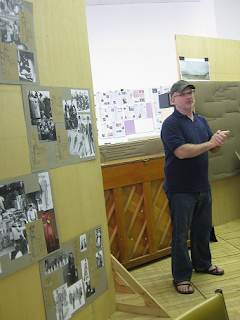
Despite the two memoirs and many personal essays Horton left behind, as well as the first-hand stories about his family and childhood he passed on to the friends and family involved in this production, we dramaturgs still have our work cut for us. The Orphans’ Home Cycle spans the years 1902 to 1928. In addition to a detailed glossary of each play citing every obscure reference from the value of $11.50 in 1904 to the history of the Romany population in Texas, we created actor packets that include American history timelines, post-Reconstruction Texas timelines, information on the economics, music, education, political and social trends of the period, and other key topics like Texas’s convict lease system (one play takes place on a plantation that employs convicts as labor, a popular practice in the post-Civil War South), the 1918 Flu Epidemic, and copious sections from Horton’s memoir, Farewell: A Memoir of a Texas Childhood. Liz and Farrell also spent two days conducting visual research at The New York Public Library Picture Collection, combing through photographs and advertisements from the 1900s through the 1920s. Many of these images will be plastered to the walls of the rehearsal room in
So we’ve done a lot of work to be as prepared as possible on the first day, but questions always come up in rehearsal that you never expect. For example, in the glossary we provided a thorough and rather graphic description of the symptoms of malaria (made all the more so by Chris’ dramatic reading of it during tablework), but director Michael Wilson wanted to know what time of year malaria is most prevalent in East Texas. This was not mere idle curiosity on his part – he needed to know in order to help determine in what season Lily Dale takes place, which is crucial information for costume designer David Woolard. These seemingly minute questions are just one ingredient to telling this story, as Michael, the actors, and designers build this world both in and out of the rehearsal room.
Now, I leave you with a sampling of some of our findings, selected by Liz and Farrell: etiquette tips from the 1905 handbook, Everyday Etiquette: A Practical Manual of Social Uses by Marion Harland and Virginia Van de Water.
“Expressions such as ‘God bless you!’ or ‘I love you,’ or ‘Love to the dear ones,’ are in shockingly bad taste except under cover of an envelope. Postcards are a solecism.”
“It takes very little to set tongues wagging. The married women should exercise extreme care in her relations with other men in public places such as a summer hotel or boarding house, while it may do no harm for a married man to flirt with other men’s wives. Promiscuous intimacies at summer resorts are a great mistake. A woman may be pleasant toward all, and intimate with none.”
“A proper young woman will never be proactive in the courting process. The girl who waits for the young man to ask if he may call her, and who waits for the young man to ask permission to write to her will be considered a prize that was difficult to win, and therefore more worthy of his true love and devotion. The apple that drops, over-ripe, at one’s feet is never quite so tempting as that which hangs just beyond reach.”
“In the home, the proper husband will always offer his wife the easy chair in which he sits when she enters the room, but “knowing that he is weary after a hard day at the office, [she] will not take the chair, but she will appreciate the little attention, and love him better for it.”
Orphans' Home Cycle Marathon Reading Day
Check out these photos from the Marathon reading of all three parts of Horton Foote's Orphans' Home Cycle, which took place at Hartford Stage on July 20, 2009.




The room hums with excitement before the
beginning of the Orphans' Home Cycle reading.


The actors gather around the reading table

Director Michael Wilson says a few words before the design presentations

Set designers Jeff Cowie and David Barber talk about their team effort


Projection designer Jan Hartley explains her role in bringing the set alive

Gathered around the designers
After a short break, back to the plays
Leading man and lady Bill Heck and Maggie Lacey
keeping their spirits up through a long, full day
Subscribe to:
Posts (Atom)